
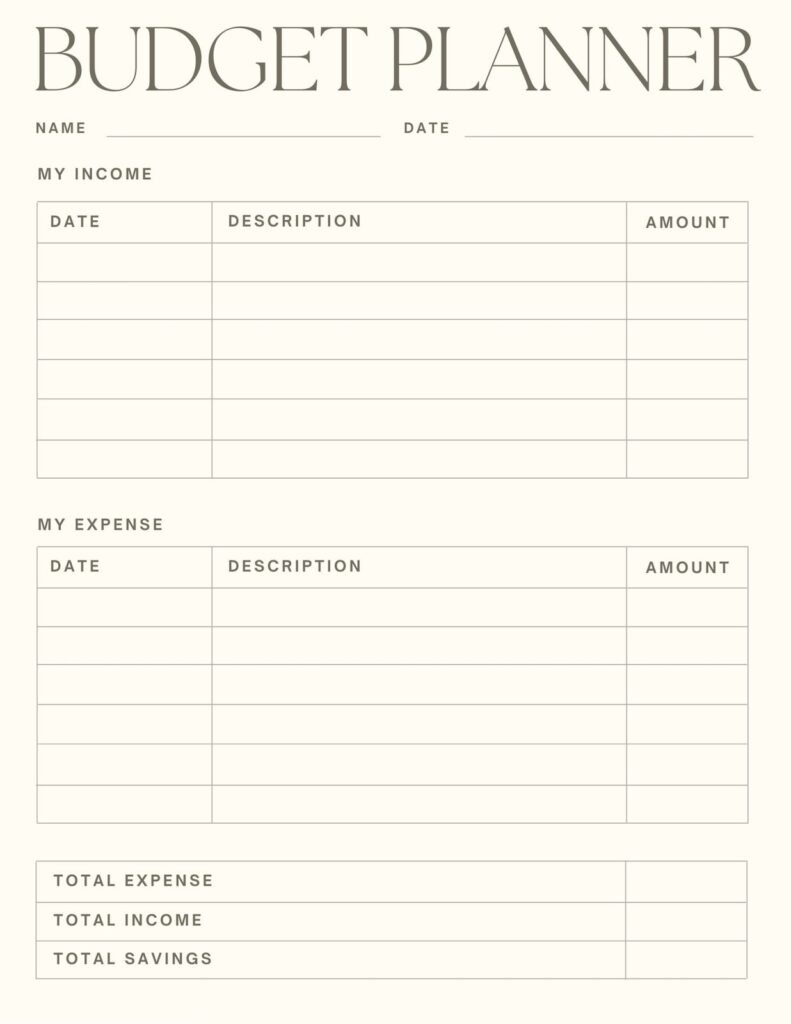
Struggling to keep track of your spending? Wondering where your paycheck disappears every month? You’re not alone. Most people start budgeting because they feel overwhelmed by bills, unexpected expenses, or the constant pressure to save more. The good news? A free printable budget planner for beginners can be your first step toward financial clarity and control—without spending a dime.
This simple, no-frills tool helps you see exactly where your money goes, set realistic goals, and build better money habits from day one. Whether you’re living paycheck to paycheck or just tired of guessing how much you spend on coffee, a beginner-friendly budget planner gives you structure without complexity.
Why Every Beginner Needs a Budget Planner
Budgeting doesn’t have to mean spreadsheets, apps, or financial jargon. For beginners, the goal is simplicity. A printable budget planner strips away the noise and focuses on what matters: income, expenses, and savings. It’s a physical reminder that you’re in charge of your money—not the other way around.
Without a plan, it’s easy to overspend on small things—like daily takeout or impulse online purchases—and wake up at the end of the month with nothing left. A budget planner helps you catch those leaks before they drain your account. It also builds awareness. When you write down every expense, you start noticing patterns: maybe you’re spending $100 a month on subscriptions you don’t use, or $50 on snacks at the gas station.
For many beginners, the biggest hurdle isn’t income—it’s consistency. A printable planner keeps you engaged. There’s something powerful about writing things down by hand. It slows you down, makes you think, and increases accountability. Plus, you can hang it on your fridge, keep it in your planner, or tuck it in your wallet—wherever you’ll see it daily.
What Makes a Great Free Printable Budget Planner for Beginners?
Not all budget planners are created equal. A good beginner-friendly version should be clear, easy to use, and designed for real life—not perfection. Here’s what to look for:
- Simple layout: No confusing charts or multiple tabs. One page, one month, one clear view.
- Space for income and expenses: Separate sections for money coming in and going out.
- Categories that make sense: Housing, groceries, transportation, entertainment—not “miscellaneous” that swallows everything.
- Room for notes: A small section to jot down unexpected costs or reminders.
- Goal tracking: A spot to write down savings targets, like “$200 for emergency fund” or “$50 for a movie night.”
Avoid planners that require advanced math or assume you already know your average spending. Beginners need room to learn, not pressure to perform. The best free printable budget planners are forgiving—they let you adjust as you go.
How to Use a Free Printable Budget Planner (Step by Step)
Using a budget planner doesn’t have to be intimidating. Follow these simple steps to get started in under 10 minutes.
Step 1: Gather Your Financial Info
Before you print or fill anything out, collect your recent bank statements, pay stubs, and bills. You’ll need to know:
- How much money you earn each month (after taxes)
- Your fixed expenses (rent, utilities, insurance)
- Your variable expenses (groceries, gas, dining out)
Don’t worry about being exact. Estimates are fine for your first month. The goal is to get a rough picture, not a perfect one.
Step 2: Print and Set Up Your Planner
Download and print your free budget planner. Choose a clean, readable design—preferably one with large spaces to write. If you’re using a PDF, make sure it prints clearly on standard letter-sized paper.
Fill in the month and year at the top. Then, list your total monthly income. This includes your salary, side gigs, child support, or any other regular cash inflows. Be honest—don’t inflate your numbers.
Step 3: List Your Expenses
Start with fixed expenses—the bills that stay the same each month. These usually include:
- Rent or mortgage
- Car payment
- Insurance (health, car, renters)
- Phone and internet
- Subscriptions (Netflix, Spotify, gym)
Next, estimate your variable expenses. These change month to month but follow patterns. Common categories include:
- Groceries
- Gas or public transit
- Dining out
- Entertainment
- Personal care (haircuts, toiletries)
- Clothing
Use your bank statements from the past month to guide your estimates. If you spent $300 on groceries last month, write $300. If you’re not sure, round up slightly to be safe.
Step 4: Subtract and Find Your Balance
Now, subtract your total expenses from your total income. The result is your monthly balance.
If the number is positive, great! You have money left over. This is your opportunity to save, pay off debt, or treat yourself responsibly.
If the number is negative, don’t panic. This is common for beginners. It just means you’re spending more than you earn. The next step is adjusting.
Step 5: Adjust and Prioritize
If you’re overspending, look for areas to cut back. Can you reduce dining out from $200 to $100? Cancel a subscription you don’t use? Switch to a cheaper phone plan?
Focus on needs first, then wants. Housing, food, and transportation are essentials. Entertainment and shopping are flexible.
Set a small savings goal—even $20 a month counts. Building the habit is more important than the amount.
Step 6: Track Daily and Review Weekly
A budget planner only works if you use it. Keep it somewhere visible and update it daily. Every time you spend money, write it down. This could be as simple as jotting “$5 coffee” under the “dining out” category.
At the end of each week, review your progress. Did you stay on track? Where did you overspend? Use this insight to adjust next week’s plan.
Don’t beat yourself up over mistakes. Budgeting is a learning process. The goal is progress, not perfection.
Top Features to Look for in a Free Printable Budget Planner
When choosing a free printable budget planner, focus on usability and practicality. Here are the most helpful features for beginners:
1. Monthly Overview
A clean monthly calendar or grid helps you see your income and expenses at a glance. Some planners include a section for due dates—like when your rent or credit card payment is due—so you never miss a bill.
2. Expense Categories
Look for a planner that includes common spending categories. This saves you time and ensures you don’t forget important areas like “medical” or “gifts.”
Some planners offer blank categories so you can customize. This is great if you have unique expenses—like pet care or student loan payments.
3. Savings Tracker
Even small savings goals matter. A dedicated section for tracking savings—like “emergency fund” or “vacation fund”—keeps you motivated.
Some planners include progress bars or checkboxes. These visual cues make it satisfying to see your progress.
4. Notes Section
Life happens. A notes area lets you record unexpected expenses, reminders, or financial wins—like “paid off $100 on credit card” or “got a $20 refund.”
This helps you stay aware and reflect on your habits over time.
5. Simple Design
Avoid planners with tiny fonts, cluttered layouts, or too many colors. Beginners benefit from clarity, not complexity.
Black and white is fine—especially if you’re printing at home. The goal is function, not flair.
Real-Life Example: How a Beginner Used a Budget Planner to Save $300
Meet Sarah, a 28-year-old teacher who felt like she was always short on cash. She earned $3,200 a month but never had money left at the end of the month. She decided to try a free printable budget planner.
Her first step was listing her income: $3,200 after taxes. Then she added her fixed expenses: $1,200 for rent, $150 for car payment, $100 for insurance, $80 for phone, and $60 for internet. That totaled $1,590.
Next, she estimated her variable expenses. Based on her last bank statement, she spent $400 on groceries, $120 on gas, $250 on dining out, $100 on entertainment, and $80 on personal care. That added up to $950.
Her total expenses were $2,540. Subtracting that from her income left $660. But she hadn’t been saving that much—so where was the money going?
She started tracking daily. Within a week, she noticed she was spending $15 a day on coffee and snacks—$450 a month! She also had three subscriptions she forgot about: a magazine ($10), a fitness app ($15), and a meal kit service ($30).
She canceled the subscriptions and switched to making coffee at home. She reduced dining out from $250 to $100 by meal prepping. In one month, she saved $305—just by using a simple printable planner.
Sarah’s story shows that small changes, guided by awareness, lead to big results. A budget planner helped her see the truth—and take action.
Common Mistakes Beginners Make (And How to Avoid Them)
Even with the best tools, beginners often stumble. Here are the most common budgeting mistakes—and how to fix them.
Mistake 1: Starting Too Complex
Some people try to track every penny in 20 categories. This leads to burnout. Beginners should start simple—5 to 7 categories max.
Focus on the big expenses first. Once you’re consistent, you can add more detail.
Mistake 2: Not Updating Regularly
A budget planner is only useful if you use it. Skipping days or weeks leads to inaccurate data and frustration.
Set a daily reminder—like after dinner—to log your spending. It takes less than two minutes.
Mistake 3: Ignoring Irregular Expenses
Car repairs, holiday gifts, and medical bills don’t happen every month—but they do happen. Beginners often forget to plan for them.
Estimate annual costs and divide by 12. For example, if you spend $600 a year on gifts, set aside $50 each month.
Mistake 4: Giving Up After One Bad Month
Life isn’t perfect. Some months you’ll overspend. That’s normal. The key is to review, learn, and keep going.
Don’t abandon your planner after a setback. Use it to understand what went wrong and adjust.
How to Find and Download a Free Printable Budget Planner
You don’t need to pay for a budget planner—there are high-quality free options available online. Here’s how to find one that works for you.
1. Search Reputable Personal Finance Websites
Look for free printables on trusted sites that focus on money management, frugal living, or financial literacy. These sites often offer clean, well-designed templates.
Avoid random blogs with pop-up ads or unclear sources. Stick to sites with good reviews or established audiences.
2. Check for Customization Options
Some free planners let you edit the categories or layout before printing. This is helpful if your expenses don’t fit standard templates.
Look for PDFs that are fillable or editable in programs like Adobe Acrobat or Google Docs.
3. Print and Test
Download a few options and print one to test. Does it fit on one page? Is the text readable? Can you write comfortably in the boxes?
If it feels cluttered or confusing, try another. The best planner is the one you’ll actually use.
4. Keep It Accessible
Store your printed planner where you’ll see it daily—on the fridge, next to your desk, or in your planner. The more visible it is, the more likely you are to use it.
Consider laminating it and using a dry-erase marker for reuse. This saves paper and makes updates easy.
Beyond the Planner: Building Long-Term Money Habits
A budget planner is a tool—not a magic solution. To build lasting financial health, pair it with smart habits.
Automate Savings
Even $10 a week adds up. Set up an automatic transfer to a savings account on payday. Out of sight, out of mind.
Review Monthly
At the end of each month, look back at your planner. What worked? What didn’t? Adjust your categories or goals for the next month.
Celebrate Small Wins
Did you stay under budget on dining out? Paid off a small debt? Treat yourself—within reason. Positive reinforcement builds motivation.
Talk About Money
Share your goals with a friend or partner. Accountability increases success. You might even inspire someone else to start budgeting.
Key Takeaways
- A free printable budget planner for beginners is a simple, effective way to take control of your money.
- It helps you track income, expenses, and savings—without apps or subscriptions.
- Look for a clean, easy-to-use design with space for categories, notes, and goals.
- Use it daily, review weekly, and adjust as needed.
- Start small, stay consistent, and focus on progress—not perfection.
FAQ
Is a free printable budget planner really effective?
Yes—especially for beginners. It provides structure, increases awareness, and helps you build consistent money habits. Many people find that writing things down by hand improves accountability more than digital tools.
Can I use a budget planner if I have irregular income?
Absolutely. Focus on your average monthly income and prioritize essential expenses. Use the planner to track fluctuations and adjust your spending accordingly. Some planners include a section for variable income.
What if I can’t stick to my budget?
That’s normal. Budgeting is a skill that improves with practice. Review your spending, identify triggers (like stress shopping), and make small adjustments. The goal is progress, not perfection.
Start Simple. Start Today.
You don’t need a high income or financial degree to manage your money well. All you need is a plan—and the willingness to try. A free printable budget planner for beginners gives you that foundation. It’s affordable, accessible, and designed for real life.
Print one today. Fill it out. Track your spending. Watch your awareness grow. And remember: every small step counts. The journey to financial freedom starts with a single page.